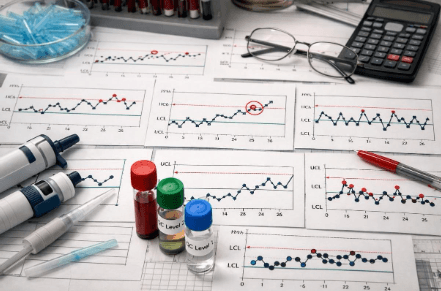
Small quality control errors do not announce themselves. They move silently through daily testing and surface later as failed audits, repeated runs, delayed reports, or worse—compromised clinical decisions. In regulated laboratory environments, even a minor shift in control values can signal a deeper analytical problem. Without organized monitoring, signals can be easy to miss.
Westgard rules were developed to apply statistical discipline to quality control. In place of visual inspection or isolated control studies, they use defined criteria to judge whether an analytical run is in control or not. They help laboratories distinguish between random variation and systematic error before patient results are released.
For clinical, blood bank, and diagnostic laboratories, this system is fundamental. Properly applied Westgard rules protect result integrity, maintain accreditation standards, and prevent costly downstream corrections.
What Are Westgard Rules and Why Laboratories Rely on Them
The Westgard rules are a set of statistical decision rules that are used to assess laboratory quality control (QC) data. They were created by Dr. James Westgard and define specific limits and patterns in the quality control data to determine whether or not an analysis run should be accepted or rejected. Rather than using a single number in the quality control data, the Westgard rules use trends and patterns in the data to determine whether or not there is instability in the data.
The main use of the Westgard rules is to detect random errors, or unpredictable variations in the data due to imprecision, and systematic errors, or consistent variations in the data due to calibration changes, reagent problems, or equipment malfunction. By recognizing these different kinds of errors, appropriate actions can be taken before any impact is made on patient results.
Westgard rules are widely used in clinical chemistry, hematology, immunochemistry, and blood bank testing, as these settings require statistical certainty. Using Westgard rules prior to reporting results is essential for ensuring accuracy, compliance, and avoiding any potential impact of erroneous reporting.
Why Quality Control Errors Still Slip Through Modern Laboratories
Yet, with the best equipment and digital instrumentation, failures still happen in the quality control process. The problem is not the equipment, nor the instrumentation, but the process around it.
Manual QC checks fail to recognize subtle trends
Technologists will typically review the control results and determine if the results fall within or out of the expected range. The problem with this process is that subtle changes will not be recognized.
Paper logs hide early warning signs
Paper logs for the quality control process fail to recognize trends and changes within the control results. It becomes labor-intensive to recognize trends and changes within the control results when reviewing the paper logs.
Delayed review increases the reporting risk
If the quality control review process is delayed and occurs after the patient results have been processed, it becomes more difficult to prevent re-reporting.
Overworked staff rely on memory instead of systems
In high-volume laboratories, cognitive load is significant. When processes depend on individual vigilance instead of automated safeguards, variability increases.
The Core Westgard Rules Every Lab Should Be Monitoring
Westgard rules are not hypothetical rules. They are actually rules implemented in day-to-day operations, protecting against inaccurate results from reaching healthcare practitioners. Each of these rules is designed specifically for a particular error pattern.
1₁s Rule
Early warning signs and trend detection
The 1₁s rule is activated when a single control result is found to be outside of ±1 standard deviation from the mean. This is not a rejection rule on its own but rather a warning sign.
The 1₁s rule essentially monitors small changes that could be indicative of calibration drifts, degradation of reagents, and even environmental factors. By monitoring such small changes, labs are able to assess potential trends before they become serious enough to violate rules and cause runs to be rejected or cause re-testing.
1₂s Rule
Identifying potential shifts before failure
The 1₂s rule is activated when a control result is found outside of ±2 standard deviations from the mean. This is still considered a warning sign in multirule QC systems but is indicative of potential systematic error.
The 1₂s rule is essentially a safety net that prevents labs from continuing runs without assessing potential issues in analytical performance.
2₂s Rule
Detecting systematic errors across runs
The violation of the 2₂s rule occurs when two consecutive results of control are beyond ±2 standard deviations on the same side of the mean. This is a clear sign of a systematic shift.
The practical application of this rule is that it prevents continuous bias from affecting entire results of patient samples. This is because calibration issues could go undetected and affect results.
R₄s Rule
Catching random error variation
The R₄s rule is violated when the difference between two results of control within a single run is beyond 4 standard deviations. This is a sign of excessive random variation.
The practical application of this rule is that it prevents imprecision in results caused by pipette issues or instrument instability.
4₁s and 10x Rules
Long-term drift and process instability
The 4₁s rule checks to see if four consecutive control values exceed ±1 standard deviation on the same side of the mean. The 10x rule checks to see if ten consecutive values fall on the same side of the mean, regardless of the values.
These rules prevent slow, progressive drift from normalizing abnormal behavior as acceptable performance. They find the underlying instability before it manifests as compliance issues, proficiency testing failures, or widespread corrections to laboratory results.
All these basic rules change QC from a passive record-keeping activity to an active error prevention discipline.
Westgard Rules Fail Without the Right System
However, these rules are effective only if they are uniformly followed and monitored in real time. If not, even the most trained and competent laboratories may face gaps in their quality control process.
Rules applied inconsistently
If quality control evaluation is left to interpretation, there is a high possibility of inconsistent application among shifts or even staff. Some shifts may consider a warning rule as a mere indicator, while others may consider it a cause for action. Such inconsistent application can undermine the quality control process as a whole.
Charts reviewed too late
If Levey–Jennings charts are examined hours after runs are completed, corrective action becomes reactive. By the time the problem is detected, patient results may already have been released, leading to possible alterations and re-testing.
Violations overlooked during busy shifts
There may also be a situation where high sample volumes and staff pressure may cause quality control to take a secondary role. This may result in recognizing violations in rules but not pursuing them, thus allowing minor instability in the analytical process to go unnoticed.
No centralized audit trail
Paper records or fragmented systems limit traceability. During audits, reconstructing QC decisions becomes time-consuming and exposes documentation weaknesses.
No visibility across instruments or departments
When QC data remains siloed, patterns across analyzers or locations are missed. Systemic issues require consolidated oversight. Statistical rules provide structure. Systems ensure they are enforced.
Also explore the benefits of Automated quality control.
Levey-Jennings Charts and Their Role in Applying Westgard Rules
Levey Jennings charts are the foundation of quality control in any laboratory. These charts help technologists visualize trends, shifts, and irregularities in control values plotted against time, using mean and standard deviation values.
Read more about Levey Jennings charts.
How Digital QC Systems Apply Westgard Rules Automatically
Digital quality control systems transform Westgard rules from theoretical safeguards into active, real-time protections. By automating evaluation on every control run, these systems eliminate the delays and inconsistencies that occur with manual processes.
Automated rule evaluation on every control run
Each control measurement is instantly checked against applicable Westgard rules, including 1₁s, 1₂s, 2₂s, R₄s, 4₁s, and 10x. Any deviation sets off instant alerts, thus enabling laboratory technologists to take corrective action before patient results are compromised.
Real-time violation alerts
Technologists are immediately notified whenever there is a violation of a rule, thus reducing the chances of errors going uncorrected. This ensures corrective action is taken at the earliest point possible.
Instrument-wise and test-wise tracking
It is possible to track the performance of QC at the instrument level, test level, and even department-wise, thus giving the laboratory an overview of the system.
Centralized quality history
All control data, rule evaluations, and corrective actions are logged centrally. This ensures an audit trail without additional effort, thus making it easier to comply with regulations.
There are solutions like Zaavia’s Quality Control Software that can integrate Westgard rules into day-to-day activities, thus ensuring accuracy, compliance, and efficiency are achieved effortlessly. Explore how it can strengthen your QC workflow today.
Applying Westgard Rules in Practice With a Quality Control Tracking System
To use Westgard rules, however, it is not just a matter of understanding statistics; rather, there must be a system in place that enforces these rules. With modern quality control tracking systems, these rules are directly integrated into the laboratory, reducing the chances of human error and increasing the reliability of results.
Built-in Westgard rule logic
All the rules are applied automatically to the results of the control, ensuring consistency in the evaluation of the results. When there are violations, the system immediately sends alerts.
Integrated Levey-Jennings charts
Control results are plotted in real time, showing trends, shifts, and random variation. Staff can quickly monitor emerging issues before they impact patient results.
Real-time visibility for supervisors
The supervisors are able to gain control of QC performance on all instruments and departments.
Reduced paper logs and manual checks
The digitization of data collection and rule evaluation reduces reliance on paper-based systems and eliminates human error.
Structured corrective action tracking
Violations are recorded and provide a complete auditable history of investigation and resolution of issues.
With Zaavia Quality Control Tracking, Westgard rules are easily implemented, making it easier for labs to ensure accuracy and regulatory compliance while streamlining operations.
Benefits for Laboratories Using Automated Westgard Rule Monitoring
The automated process reduces reporting error to a minimum by detecting problems before reporting. Problems are identified immediately, thus enabling timely interventions. The QC process is implemented uniformly across shifts and instruments, thus reducing the need to monitor manually. The process reduces the workload, thus enabling the staff to be fully effective, while the records enhance inspection readiness.
Who Should Use Automated Westgard Rule Software
- Clinical laboratories
- Diagnostic centers
- Hospital laboratories
- Reference laboratories
- Multi-location laboratory networks
Conclusion
The Westgard rules are effective in ensuring the accuracy of the results, but this can be achieved by implementing the rules consistently, transparently, and in real time. The reliable digital QC process works with the expertise of the laboratory to deliver automated rule evaluation, trends, and records, thus enabling the laboratory to deliver precise and accurate results with confidence in every patient result.